What Does “Termination” Mean?
Quick Definition
Termination means the act of ending, stopping, or bringing something to a conclusion.
Literal Meaning of Termination
The word comes from “terminate,” which means:
- To end
- To stop
- To finish
- To conclude
What Termination Means in Everyday Use
In everyday conversations, termination can refer to:
- Ending an activity
- Ending an agreement
- Ending a service
- Stopping a process
Example:
“The termination of the project was announced.”
Meaning:
The project was ended.
What Tone Does Termination Convey?
Termination often sounds formal or serious.
Neutral:
“The contract termination was completed.”
Meaning:
The agreement ended.
Serious:
“His employment was terminated.”
Meaning:
He lost his job.
Technical:
“The program terminated unexpectedly.”
Meaning:
The software stopped running.
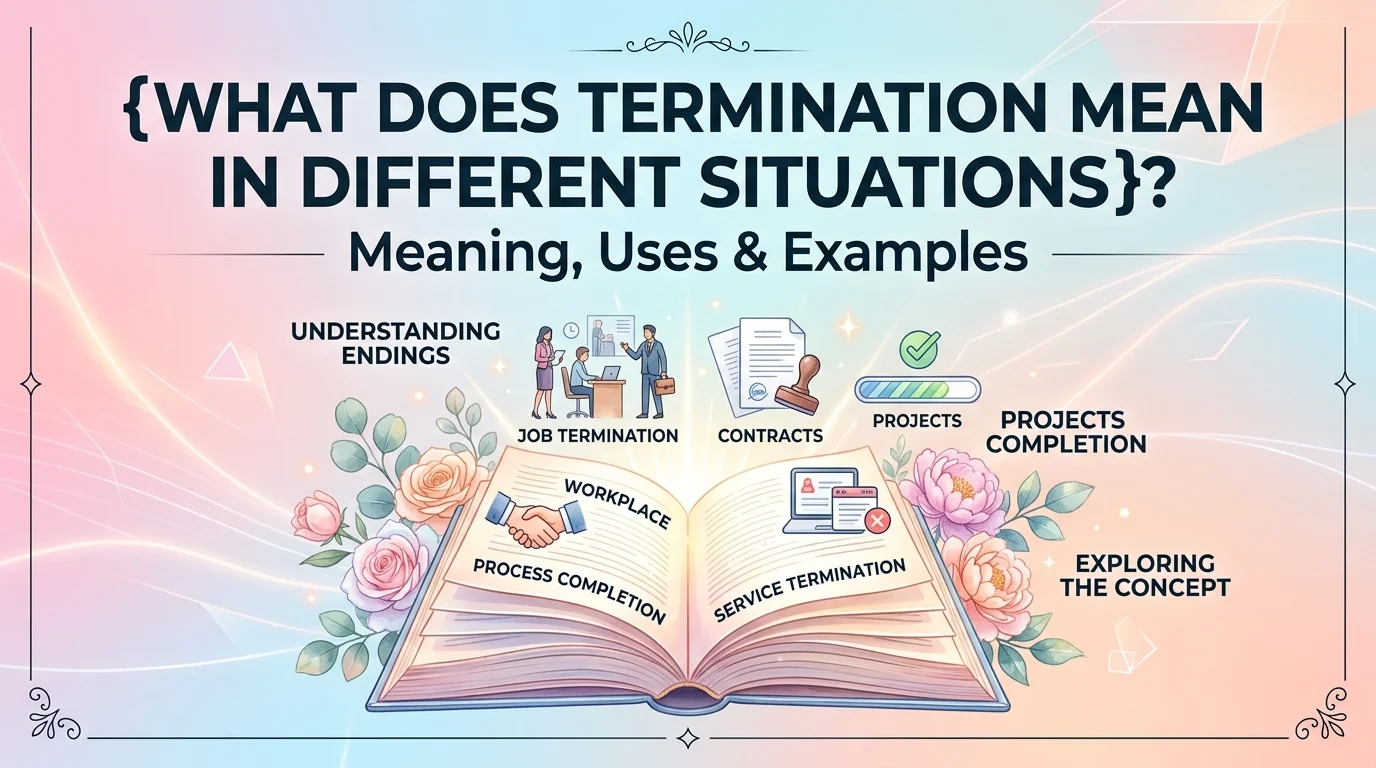
What Does Termination Mean in Different Situations?
Termination Meaning in Employment
In jobs, termination means the end of an employee’s employment with a company.
It can happen because of:
- Company decisions
- Performance issues
- Policy violations
- Layoffs
- Resignation
Example:
“Your employment has been terminated.”
Meaning:
The person is no longer employed by the company.
Types of Employment Termination
Voluntary Termination
When an employee chooses to leave.
Example:
A person resigns from a job.
Involuntary Termination
When the company ends the employment.
Example:
An employee is fired.
Termination Due to Layoff
When a company removes positions because of business reasons.
Termination Meaning in Contracts
In legal and business situations, termination means ending a contract or agreement.
Example:
“The service agreement was terminated.”
Meaning:
The agreement is no longer active.
Reasons may include:
- Contract expiration
- Breach of terms
- Mutual agreement
- Business changes
Termination Meaning in Technology
In technology, termination means stopping a process, connection, or program.
Examples:
“Application terminated.”
Meaning:
The app stopped running.
“Connection terminated.”
Meaning:
The connection ended.
Termination Meaning in Relationships
In relationships, termination can mean ending a relationship or connection.
Example:
“The termination of the partnership was mutual.”
Meaning:
The relationship or partnership ended by agreement.
Termination Meaning in Medical Context
In medical discussions, termination can refer to ending a pregnancy or stopping a medical process. This meaning depends heavily on the specific context and terminology being used.
Origin and History of Termination
The word “termination” comes from the Latin word “terminus,” meaning an end, boundary, or limit.
Over time, the word developed into a formal English term used in many areas, including:
- Law
- Business
- Employment
- Science
- Technology
Because it sounds official, it is commonly used in professional and formal communication.
How People Actually Use Termination
Most people see “termination” in formal situations rather than casual conversations.
You’ll often find it in:
- Job documents
- Contracts
- Company emails
- Legal paperwork
- Software messages
When to Use It
Use termination when discussing:
- Official endings
- Formal agreements
- Employment decisions
- Technical processes
Examples:
“The termination date is next Friday.”
“The contract termination was confirmed.”
When Not to Use It
Avoid using “termination” in casual situations where simpler words work better.
Instead of:
“The termination of our dinner plans”
Say:
“We canceled our dinner plans.”
Real Examples of Termination in Conversations
Example 1: Workplace
Person A:
“Why is John leaving the company?”
Person B:
“His employment was terminated.”
Meaning:
His job ended.
Example 2: Contract
Person A:
“Is the agreement still active?”
Person B:
“No, it reached termination.”
Meaning:
The agreement ended.
Example 3: Technology
Person A:
“Why did the app close?”
Person B:
“The process terminated.”
Meaning:
The program stopped.
Example 4: Subscription
Person A:
“Why can’t I access the service?”
Person B:
“Your subscription was terminated.”
Meaning:
The service ended.
Example 5: Business
Person A:
“Are they still partners?”
Person B:
“No, the partnership was terminated.”
Meaning:
The partnership ended.
Example 6: Formal Notice
Person A:
“What does this letter mean?”
Person B:
“It is a termination notice.”
Meaning:
A formal message ending something.
Common Mistakes and Misunderstandings
Mistake 1: Thinking Termination Always Means Being Fired
Termination can mean any ending, not only losing a job.
Mistake 2: Confusing Termination With Resignation
Resignation usually means someone chooses to leave.
Termination may be decided by another party.
Mistake 3: Assuming Termination Is Always Negative
Some terminations are normal, such as ending an expired contract.
Similar Terms and Related Words
| Term | Meaning | Difference |
|---|---|---|
| End | Stop something | Simple and general |
| Cancel | Stop a plan or service | Usually before completion |
| Finish | Complete something | Often positive |
| Expire | End naturally over time | Common for dates/contracts |
| Dismiss | Remove someone from a job | Employment-related |
| Resign | Leave voluntarily | Employee choice |
| Cancelation | Ending an arrangement | Less formal |
| Closure | Final ending | Often emotional or complete |
Is Termination Positive, Negative, or Neutral?
Termination is usually neutral, but the feeling depends on context.
Positive:
“The contract termination helped start a better opportunity.”
Negative:
“He received a job termination notice.”
Neutral:
“The service termination date is listed.”
Should You Use Termination?
Use It If:
- Writing formally
- Discussing contracts
- Talking about official endings
Avoid It If:
- Casual language is better
- You want a softer expression
Examples:
Formal:
“Employment termination”
Casual:
“Leaving the job”
Related posts:
 Coed Meaning Explained Powerful Guide to Its Definition, History, Uses & Examples 2026
 Important COO Meaning in Business Explained What Does COO Stand For? 2026
 Congeniality Meaning Explained The Positive Quality Behind Friendly & Pleasant People 2026
 Demographics Meaning Explained Powerful Guide to Definition, Examples & Importance 2026