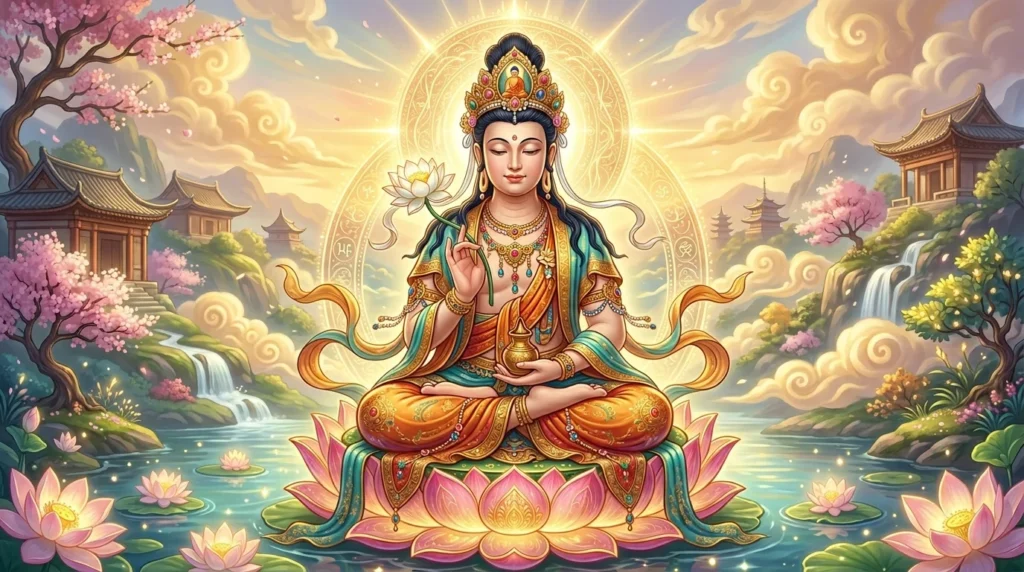

What Does “Bodhisattva” Mean?
Quick Definition
A bodhisattva is an individual who strives to attain enlightenment while dedicating themselves to helping all beings achieve freedom from suffering.
Literal Meaning
The word comes from Sanskrit:
- Bodhi = awakening, enlightenment, or wisdom
- Sattva = being, person, or sentient being
Together, bodhisattva roughly means:
“An enlightened being” or “one dedicated to awakening.”
What It Usually Means in Buddhism
In Buddhist teachings, a bodhisattva makes a commitment to pursue enlightenment while working tirelessly for the benefit of others.
This commitment is often called the Bodhisattva Vow, which emphasizes compassion toward all living beings.
What Qualities Does a Bodhisattva Convey?
A bodhisattva is commonly associated with:
- Compassion
- Wisdom
- Patience
- Generosity
- Selflessness
- Kindness
- Moral discipline
These qualities make the bodhisattva an important spiritual role model.

What Does Bodhisattva Mean in Different Contexts?
In Mahayana Buddhism
Mahayana Buddhism places the bodhisattva at the center of spiritual practice.
Followers seek not only personal enlightenment but also the liberation of all beings.
In Theravada Buddhism
The term exists in Theravada Buddhism but is used differently.
It generally refers to someone who is on the path to becoming a Buddha in a future life.
In Modern Spirituality
Outside traditional Buddhism, people sometimes use bodhisattva to describe:
- Exceptionally compassionate individuals
- Spiritual teachers
- People devoted to helping others
In Popular Culture
The term occasionally appears in:
- Books
- Movies
- Meditation communities
- Philosophy discussions
In these contexts, it often symbolizes wisdom and compassion.
In Everyday Conversation
Although uncommon in casual texting, someone may describe another person as a “bodhisattva” to praise their kindness and selflessness.
Origin and History of Bodhisattva
The concept of the bodhisattva has ancient roots in Buddhist teachings dating back more than two thousand years.
Historically, the term was used to describe the previous lives of Siddhartha Gautama before he became the Buddha.
As Mahayana Buddhism developed, the bodhisattva ideal expanded into a central spiritual path. Instead of seeking enlightenment solely for oneself, practitioners embraced the goal of helping all beings attain liberation.
Over time, numerous revered bodhisattvas became important figures in Buddhist traditions throughout Asia.
How People Actually Use Bodhisattva
Most people encounter the word in:
- Buddhist books
- Meditation courses
- Philosophy classes
- Spiritual discussions
- Religious studies
When to Use It
Use bodhisattva when discussing:
- Buddhism
- Spiritual development
- Compassionate service
- Enlightenment
- Buddhist philosophy
When Not to Use It
Avoid using the term casually if:
- The audience is unfamiliar with Buddhism
- You are using it inaccurately
- The context requires simpler language
Most People Use It When…
Most people use the term while discussing:
- Compassion
- Meditation
- Buddhist teachings
- Spiritual goals
- Personal growth
Real Examples of Bodhisattva in Conversations
Example 1: Buddhism Class
Person A:
What is a bodhisattva?
Person B:
Someone who seeks enlightenment while helping others do the same.
Meaning:
A basic Buddhist definition.
Why it was used:
To explain the concept simply.
Example 2: Meditation Group
Person A:
What is the goal of a bodhisattva?
Person B:
To reduce suffering for all beings.
Meaning:
A key aspect of the bodhisattva path.
Why it was used:
To discuss Buddhist teachings.
Example 3: Spiritual Discussion
Person A:
She’s always helping people.
Person B:
She’s like a bodhisattva.
Meaning:
A compliment for extraordinary compassion.
Why it was used:
To praise selflessness.
Example 4: Book Club
Person A:
Why is the bodhisattva important?
Person B:
Because compassion is central to Mahayana Buddhism.
Meaning:
Discussing religious philosophy.
Why it was used:
Educational context.
Example 5: Philosophy Class
Person A:
What’s different about a bodhisattva?
Person B:
They focus on helping others reach enlightenment too.
Meaning:
Explaining a unique Buddhist ideal.
Why it was used:
Academic discussion.
Common Mistakes and Misunderstandings
Thinking a Bodhisattva Is a God
A bodhisattva is not necessarily a god.
In Buddhism, bodhisattvas are enlightened or awakening beings dedicated to helping others.
Assuming Every Buddhist Is a Bodhisattva
Not all Buddhists identify as bodhisattvas.
The term refers to a specific spiritual path and commitment.
Confusing Bodhisattvas With Buddhas
While related, the concepts differ.
A Buddha has attained full enlightenment, while a bodhisattva is traditionally committed to helping others along the path to enlightenment.
Using the Term Too Broadly
Calling anyone kind a bodhisattva can overlook the term’s deeper religious significance.
Similar Terms and Related Concepts
| Term | Meaning | Difference |
|---|---|---|
| Bodhisattva | Being dedicated to enlightenment for all | Focuses on compassion and service |
| Buddha | Fully awakened one | Has attained complete enlightenment |
| Dharma | Buddhist teachings | Refers to teachings, not a person |
| Karma | Actions and consequences | Moral cause and effect |
| Nirvana | Liberation from suffering | Spiritual goal |
| Monk | Religious practitioner | Not necessarily a bodhisattva |
| Enlightenment | Spiritual awakening | State rather than person |
| Compassion | Concern for others | A key bodhisattva quality |
| Meditation | Spiritual practice | Tool for development |
| Wisdom | Deep understanding | Essential bodhisattva trait |
Is Bodhisattva Positive, Negative, or Neutral?
Bodhisattva is overwhelmingly positive.
The term is associated with:
- Compassion
- Wisdom
- Service
- Spiritual growth
- Kindness
In Buddhist traditions, it represents one of the highest ideals a person can pursue.
Should You Use Bodhisattva?
Use It If:
- You are discussing Buddhism.
- You are studying religion or philosophy.
- You are talking about compassion and spiritual growth.
- You understand the term’s meaning.
Avoid It If:
- You are using it merely as a trendy label.
- The audience may misunderstand it.
- You are discussing unrelated topics.
Related posts:
 Useful Nervy Meaning Explained What Does Nervy Mean in Text, Slang & Everyday Use? 2026
 504 Meaning Explained Powerful Definition, Text Examples, Internet Slang & Hidden Meanings 2026
 Chaser Meaning Explained Powerful Guide to Definition, Uses, Examples & Different Contexts 2026
 BMF Meaning SZA Powerful Explanation of What BMF Really Means 2026