
What Does “Strait Meaning” Mean?
Quick Definition
A strait is a narrow water passage that connects two larger bodies of water.
It can also mean a difficult or restricted situation in formal or historical language.
What It Usually Means in Geography
In geography, a strait is:
- A narrow channel of water
- Located between land areas
- Connecting seas, oceans, or lakes
Example:
The Strait of Gibraltar connects the Atlantic Ocean and the Mediterranean Sea.
What Tone Does It Convey?
The word “strait” depends on context.
It can feel:
- Geographical: When discussing waterways
- Formal: When describing difficult situations
- Neutral: As a location term
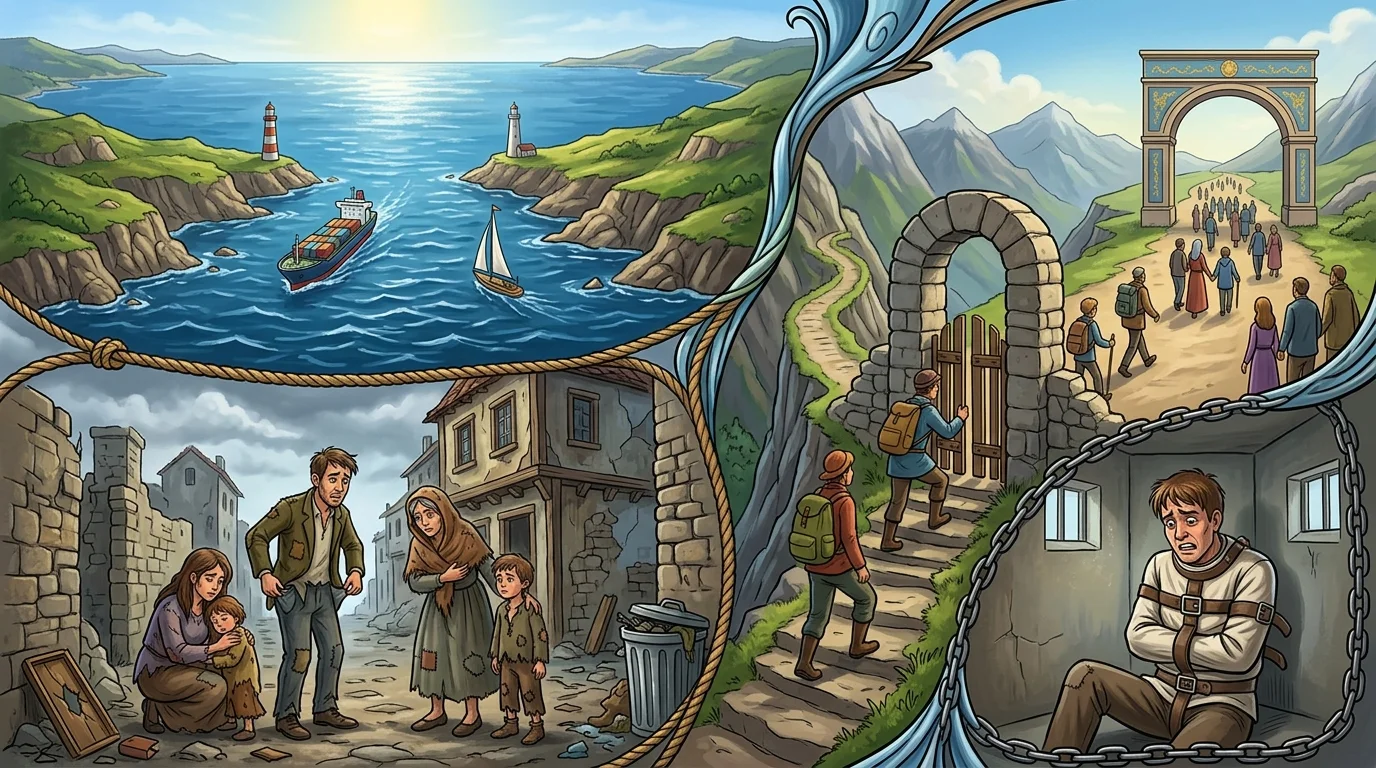
What Does Strait Mean in Different Contexts?
Strait Meaning in Geography
The main use of strait is related to physical geography.
Examples:
- Strait of Gibraltar
- Bering Strait
- Strait of Hormuz
These waterways are important for:
- Shipping
- Trade routes
- Navigation
Strait Meaning in History
Historical texts sometimes use strait to describe hardship or difficulty.
Example:
“They were in desperate straits.”
Meaning:
They were facing serious problems.
Strait Meaning in Everyday Language
In modern everyday speech, the geographic meaning is much more common.
Most people use strait when talking about:
- Maps
- Oceans
- Travel
- Countries and borders
Strait Meaning in Business or Finance
The phrase “in dire straits” means being in a very difficult situation.
Example:
“The company was in dire straits after losing money.”
Meaning:
The company was struggling badly.
Origin and History of Strait
The word strait comes from the Latin word strictus, meaning “tight” or “narrow.” It entered English through Old French.
The original idea behind the word was something narrow or restricted. Over time, it became associated with narrow waterways and difficult conditions.
Today, the geographic meaning is the most common use.
How People Actually Use Strait
Most people encounter strait in:
- Geography classes
- News reports
- Maps
- Historical books
- Maritime discussions
When It Is Used Correctly
Example:
“The ship passed through the strait.”
Meaning:
The ship traveled through a narrow water passage.
When Not to Use It
Do not use “strait” when you mean “straight.”
Incorrect:
“Walk strait ahead.”
Correct:
“Walk straight ahead.”
Real Examples of Strait in Conversations
Example 1: Geography Class
Person A: What is a strait?
Person B: It is a narrow water passage between land areas.
Meaning: A geographic waterway.
Example 2: Travel
Person A: How do ships reach the other sea?
Person B: They pass through the strait.
Meaning: A narrow connection between waters.
Example 3: News
Person A: Why is the Strait of Hormuz important?
Person B: It is a major shipping route.
Meaning: A strategic water passage.
Example 4: History
Person A: What does “dire straits” mean?
Person B: It means being in a very difficult situation.
Meaning: Facing serious problems.
Example 5: Map Discussion
Person A: Why is this area important?
Person B: Because the strait connects two major seas.
Meaning: A geographic connection.
Example 6: Business
Person A: How is the company doing?
Person B: It is in dire straits.
Meaning: The company is struggling.
Example 7: Shipping
Person A: Why do ships use this route?
Person B: The strait provides a shorter path.
Meaning: A narrow water route.
Example 8: Learning Vocabulary
Person A: Is strait the same as straight?
Person B: No, they have different meanings.
Meaning: Similar spelling but different definitions.
Common Mistakes and Misunderstandings
Mistake 1: Confusing Strait With Straight
This is the most common mistake.
- Strait = narrow water passage
- Straight = direct, not curved
Mistake 2: Thinking Strait Only Means Geography
The phrase “dire straits” uses a different meaning related to difficulty.
Mistake 3: Pronunciation Confusion
Strait and straight are pronounced the same but have different meanings.
Similar Terms and Related Words
| Term | Meaning | Difference |
|---|---|---|
| Straight | Direct or not curved | Different spelling and meaning |
| Channel | Passage for water or communication | Broader term |
| Passage | A way through something | Not always water-related |
| Narrow | Having little width | Describes size |
| Route | A way or path | More general |
| Waterway | A body of water used for travel | Broader geography term |
| Isthmus | Narrow land connection | Opposite type of land feature |
| Sea | Large body of salt water | Larger than a strait |
Is Strait Positive, Negative, or Neutral?
Strait is usually neutral.
The meaning depends on context:
- A geographic strait is neutral.
- Being in “dire straits” is negative.
The word itself does not automatically express emotion.
Should You Use the Word Strait?
Use It If:
- You are discussing geography
- You are describing a narrow water passage
- You are using the phrase “dire straits”
Avoid Using It If:
- You mean “straight”
- You are describing a normal path or direction
Related posts:
 What Does “The Hierophant Meaning” Mean? Powerful Tarot Symbolism, Spiritual Insight & Life Guidance 2026
 Partake Meaning Explained Powerful Definition, Examples, Usage & Complete Guide 2026
 PMU Meaning Made Easy Complete Guide to Beauty, Technology & Business 2026
 These Meaning Explained Amazing Guide to Using “These” Correctly in English 2026