What Does “Demonic” Mean?
Quick Definition
Demonic means related to demons or having qualities that are considered evil, cruel, or supernatural.
Literal Meaning
In its literal sense, demonic describes something connected with demons or evil spirits in religious, spiritual, or mythological traditions.
Examples include:
- Demonic possession
- Demonic forces
- Demonic entities
- Demonic rituals (in fictional or religious contexts)
Figurative Meaning
Outside of religion, people often use demonic as an exaggeration to describe something that seems:
- Extremely evil
- Violent
- Cruel
- Out of control
- Frightening
- Wild or chaotic
For example:
- “The engine made a demonic noise.”
- “He gave a demonic laugh.”
These examples don’t mean actual demons are involved—they simply emphasize intensity or fear.
What Tone Does It Convey?
The word usually has a:
- Serious tone
- Dark tone
- Horror-related tone
- Dramatic tone
Depending on context, it may also be used humorously or hyperbolically.
Where Is the Word “Demonic” Commonly Used?
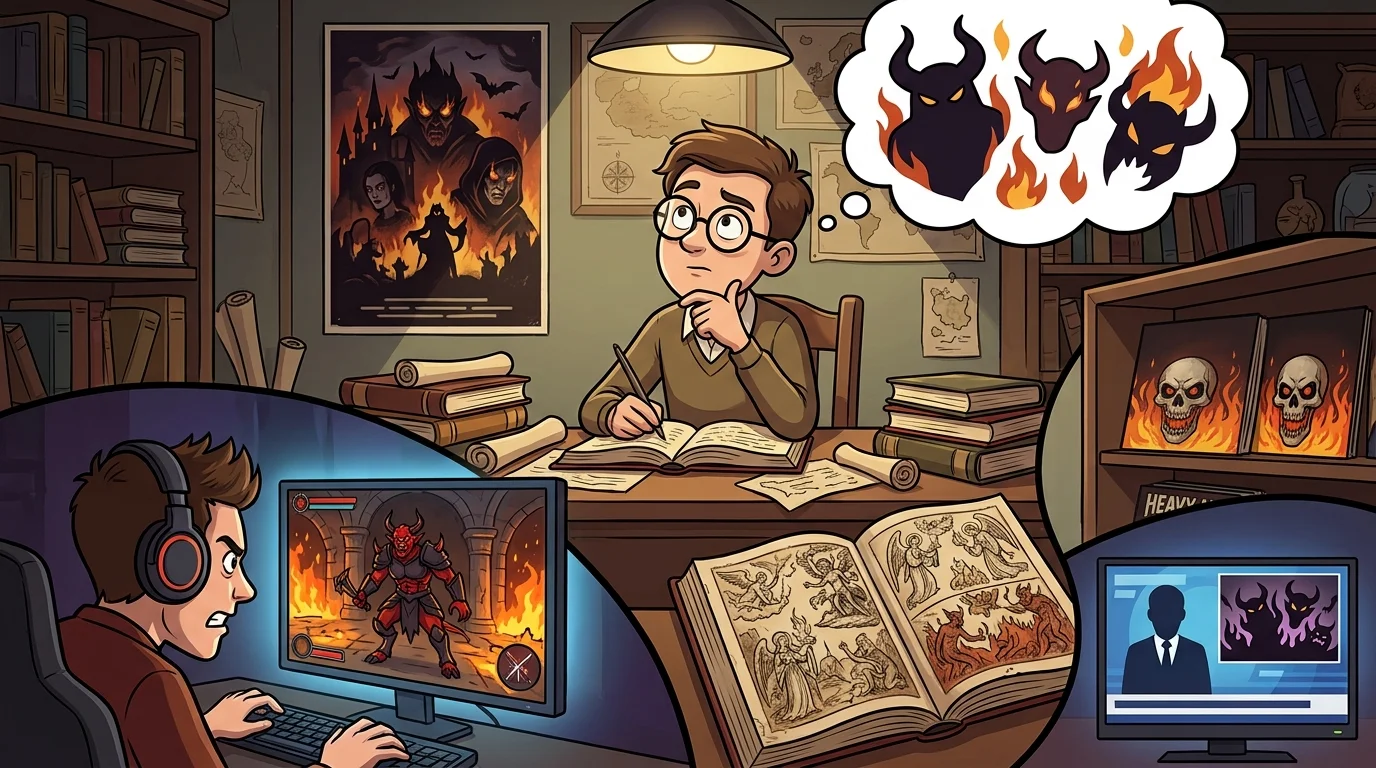
Religion
In many religions, demonic refers to demons or evil spiritual beings that oppose good or divine forces.
Literature
Authors use demonic characters or creatures to create conflict, horror, or suspense.
Movies and TV
Horror films often feature demonic possessions, cursed objects, or supernatural villains.
Gaming
Fantasy and role-playing games frequently include demonic enemies, powers, or realms as fictional elements.
Everyday Conversation
People sometimes use the word to exaggerate someone’s behavior or the appearance of an object.
Example:
“That cat had a demonic stare when I walked past.”
Origin and History of Demonic
The word demonic comes from the noun demon, which traces back to the ancient Greek word daimōn. In ancient Greek, daimōn originally referred to a spirit or divine power rather than an inherently evil being.
Over time, especially through religious traditions and later literature, the meaning shifted in English to refer primarily to evil spirits. The adjective demonic developed to describe anything associated with demons or resembling their perceived qualities.
How People Actually Use Demonic
Most people use the word in one of three ways:
Literally
When discussing religion, mythology, or supernatural beliefs.
Example:
“The story describes a demonic spirit.”
Figuratively
To emphasize something extremely frightening or cruel.
Example:
“His demonic scream startled everyone.”
Humorously
Friends sometimes use it jokingly.
Example:
“My toddler turned demonic after missing nap time.”
In these cases, no one is suggesting actual supernatural activity.
Real Examples of Demonic in Sentences
Example 1
Person A: Did you hear that noise?
Person B: It sounded absolutely demonic.
Meaning: The noise was extremely frightening.
Example 2
Person A: Why is the cat staring like that?
Person B: It has a demonic look today.
Meaning: The cat’s expression seems creepy.
Example 3
“The villain had a demonic smile.”
Meaning: The smile looked evil or unsettling.
Example 4
“The movie features demonic creatures.”
Meaning: The story includes fictional demons.
Example 5
“My alarm clock made a demonic sound this morning.”
Meaning: The sound was harsh or unpleasant.
Example 6
“The actor gave a demonic laugh.”
Meaning: The laugh sounded sinister.
Example 7
“The game includes demonic bosses.”
Meaning: Fictional enemies based on demons.
Example 8
“The weather felt almost demonic during the storm.”
Meaning: The storm seemed terrifying.
Example 9
“That prank was demonic.”
Meaning: The prank was especially mean or shocking.
Example 10
“The novel explores demonic symbolism.”
Meaning: It includes themes related to demons.
Common Mistakes and Misunderstandings
Many people misunderstand the word demonic. Here are a few common mistakes:
- Assuming it always refers to real demons: In many cases, it’s simply a figurative description.
- Confusing it with “devilish”: While similar, “devilish” can also mean playful or mischievous, whereas “demonic” usually carries a darker tone.
- Using it for minor annoyances: Because the word is strong, it’s best reserved for situations that are genuinely intense or dramatic.
Similar Words and Related Terms
| Word | Meaning | Difference |
|---|---|---|
| Demon | Evil spirit | The noun form |
| Devilish | Mischievous or evil | Can have a playful meaning |
| Sinister | Threatening or evil | Doesn’t necessarily involve the supernatural |
| Evil | Morally bad | Broader than demonic |
| Malevolent | Wishing harm | Focuses on harmful intent |
| Fiendish | Extremely cruel | Often figurative |
| Infernal | Hell-related | More literary |
| Supernatural | Beyond natural explanation | Neutral term |
| Possessed | Controlled by a spirit | Refers to a person’s condition |
| Monstrous | Shockingly cruel | Doesn’t imply demons |
Is Demonic Positive, Negative, or Neutral?
Demonic is almost always negative.
It typically suggests:
- Evil
- Danger
- Cruelty
- Fear
- Darkness
- Supernatural menace
In casual speech, however, it can be used humorously without implying genuine evil.
Should You Use the Word Demonic?
Use it when:
- Describing horror stories or fantasy.
- Talking about mythology or religion.
- Emphasizing something extremely frightening or sinister.
Avoid using it when:
- Referring to ordinary situations that don’t warrant such a strong description.
- Describing real people in a way that could be insulting or offensive.
Related posts:
 What Does “The Hierophant Meaning” Mean? Powerful Tarot Symbolism, Spiritual Insight & Life Guidance 2026
 Nolan Name Meaning Explained Amazing Guide to Origin, History, Personality & Symbolism 2026
 TOC Meaning Explained Ultimate Guide to the Best Definitions, Business, Medical & Text Uses 2026
 Cognition Meaning The Best Ultimate Guide to Understanding Cognition in Psychology & Everyday Life 2026