What Does “Discordant Meaning” Mean?
The discordant meaning refers to lack of harmony, agreement, or pleasantness between things—whether sounds, ideas, or emotions.
Quick Definition
Discordant means not in harmony; conflicting, harsh, or unpleasant in tone, sound, or situation.
What It Usually Means in Context
Depending on usage, discordant can mean:
- Clashing sounds (music or noise)
- Conflicting ideas or opinions
- Emotional tension or discomfort
- Things that don’t fit together naturally
What Tone Does It Convey?
The tone of “discordant” is usually:
- Negative
- Uneasy
- Tense
- Critical
- Uncomfortable
It is rarely used in a positive sense.
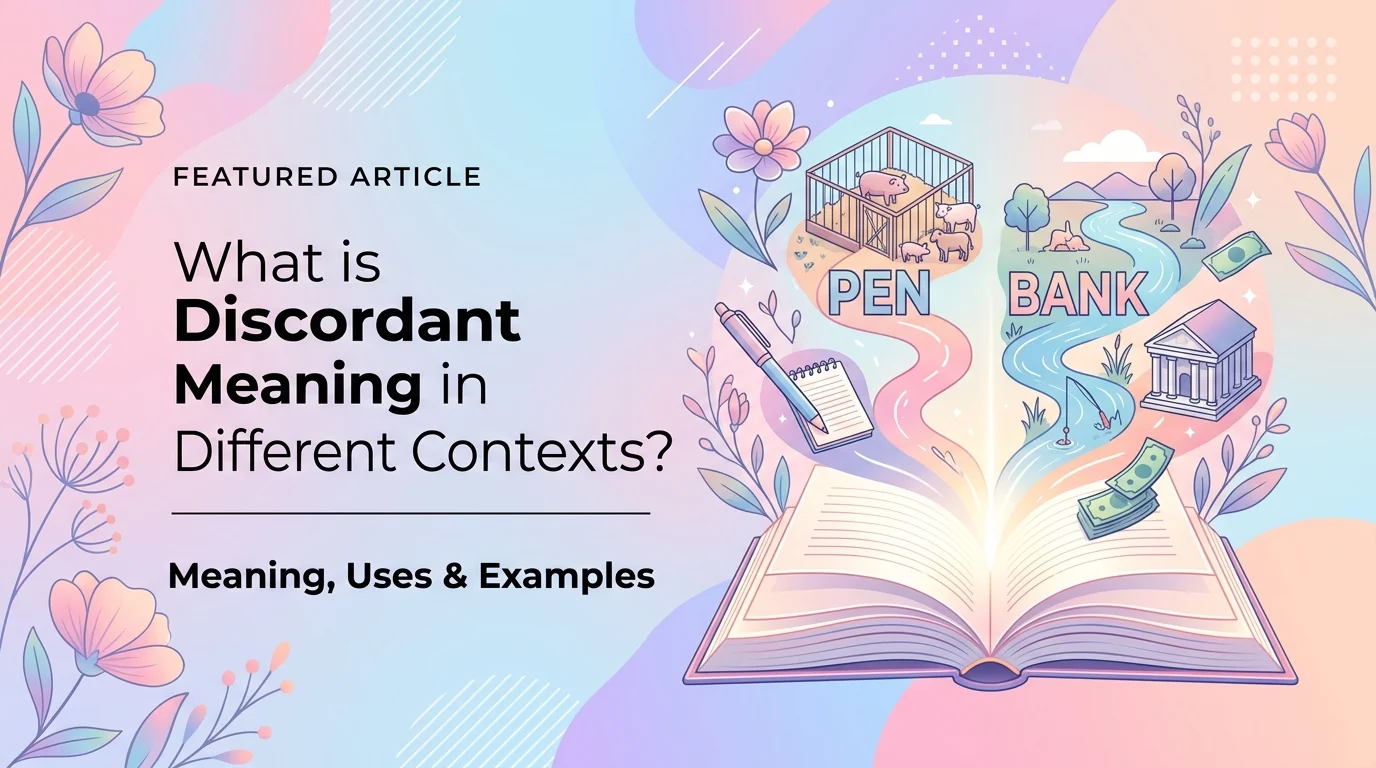
Discordant Meaning in Different Contexts
Music Context
In music, discordant refers to:
- Notes that sound harsh together
- Lack of harmony
- Intentionally chaotic or experimental sound
Example:
- “The jazz piece had a discordant melody.”
Conversation Context
In speech or writing, it means:
- Conflicting opinions
- Arguments or disagreement
- Lack of agreement in ideas
Example:
- “Their views were discordant on politics.”
Emotional Context
It can describe feelings or situations:
- Emotional tension
- Internal conflict
- Uncomfortable atmosphere
Example:
- “There was a discordant feeling in the room after the argument.”
Social Context
Used to describe groups or relationships:
- Lack of unity
- Conflicting behavior or beliefs
- Tension between people
Example:
- “The team’s discordant behavior affected performance.”
Origin and History of Discordant
The word “discordant” comes from the Latin root:
- “Discordare” meaning “to disagree”
- Related to “discord,” meaning conflict or disagreement
Historically, it has been used in:
- Classical literature
- Music theory
- Philosophical and academic writing
It has always carried the idea of lack of harmony or agreement.
How People Actually Use Discordant Meaning
People use “discordant” when describing something that feels off or conflicting.
When to Use It
- Describing music or sound quality
- Talking about arguments or disagreements
- Writing essays or formal analysis
- Describing emotional tension
When Not to Use It
- Casual texting slang conversations
- Simple everyday speech (unless formal tone is needed)
- Fun or humorous chats
Real-Life Observation
Most people use “discordant” in:
- Academic writing
- Music reviews
- Emotional storytelling
- Analytical discussions
It is not a trendy slang word but a formal descriptive term.
Real Examples of Discordant Meaning in Conversations
Example 1:
“The music had a discordant tone that made it hard to enjoy.”
Meaning: Sounds were harsh and not pleasant.
Example 2:
“Their opinions were discordant during the meeting.”
Meaning: They disagreed strongly.
Example 3:
“There was a discordant silence after the argument.”
Meaning: Uncomfortable tension in the room.
Example 4:
“The painting used discordant colors to create emotional impact.”
Meaning: Colors clashed intentionally.
Example 5:
“The group’s discordant voices made decision-making difficult.”
Meaning: Lack of unity.
Example 6:
“I felt a discordant energy between them.”
Meaning: Emotional tension or mismatch.
Example 7:
“The orchestra sounded discordant in the first rehearsal.”
Meaning: Instruments were not in harmony.
Example 8:
“The speech had a discordant message compared to earlier promises.”
Meaning: Conflicting ideas.
Example 9:
“The conversation became discordant after the topic changed.”
Meaning: Disagreement started.
Example 10:
“There was a discordant mix of emotions in the room.”
Meaning: Mixed, conflicting feelings.
Common Mistakes and Misunderstandings
Many people confuse “discordant” with similar words.
Wrong Interpretations:
- It means silence ❌
- It means confusion only ❌
- It means random noise only ❌
Correct Understanding:
- It means lack of harmony ✔
- It can describe sound, emotion, or ideas ✔
- It implies conflict or tension ✔
How to Avoid Confusion
Always check context—music, emotion, or conversation determines the exact meaning.
Similar Words and Related Terms
| Word | Meaning | Difference |
|---|---|---|
| Dissonant | Harsh sound | Mostly musical context |
| Conflicting | Opposing ideas | Broader usage |
| Clashing | Not fitting together | Visual or idea-based |
| Inharmonious | Not in harmony | More formal |
| Discord | Conflict or disagreement | Noun form |
| Uneasy | Emotional discomfort | Feeling-based |
| Tense | Stressful situation | Emotional intensity |
| Chaotic | Disordered | Broader disorder |
Is Discordant Meaning Positive, Negative, or Neutral?
The discordant meaning is mostly negative.
Emotional Tone:
- Negative ✔ (most common)
- Neutral ✔ (in analytical writing)
- Rarely positive ❌
Situational Meaning:
- Negative in emotions and relationships
- Neutral in artistic or musical description
Relationship Context:
It usually signals disagreement or lack of harmony between people or ideas.
Should You Use Discordant?
Use it if:
- You are writing formally or academically
- You are describing music or art
- You want a precise descriptive word
Avoid it if:
- You are texting casually
- You want simple slang or everyday language
- Your audience may not understand advanced vocabulary
Related posts:
 What Does “The Hierophant Meaning” Mean? Powerful Tarot Symbolism, Spiritual Insight & Life Guidance 2026
 Bubba Meaning Revealed The Surprising Story Behind This Friendly Nickname 2026
 Chaser Meaning Explained Powerful Guide to Definition, Uses, Examples & Different Contexts 2026
 Powerful Meaning of Medusa Tattoo Symbolism, History & Hidden Messages 2026