What Does “Dominion” Mean?
Quick Definition
Dominion means:
- Control
- Authority
- Rule
- Power
- Ownership
Literal Meaning of Dominion
The word comes from Latin “dominus,” meaning “lord” or “master.”
The original idea was connected with having authority or control over something.
What Dominion Means in Everyday Use
In everyday language, dominion describes a situation where someone has power or influence.
Examples:
“The company has dominion over the market.”
Meaning:
The company has strong control or influence.
“The king ruled with dominion.”
Meaning:
The king had authority.
What Tone Does Dominion Convey?
Dominion usually sounds formal, powerful, or historical.
Political:
“The nation expanded its dominion.”
Meaning:
The nation increased its control.
Personal:
“She regained dominion over her life.”
Meaning:
She regained control.
Religious:
“Humanity was given dominion over nature.”
Meaning:
Authority or responsibility.
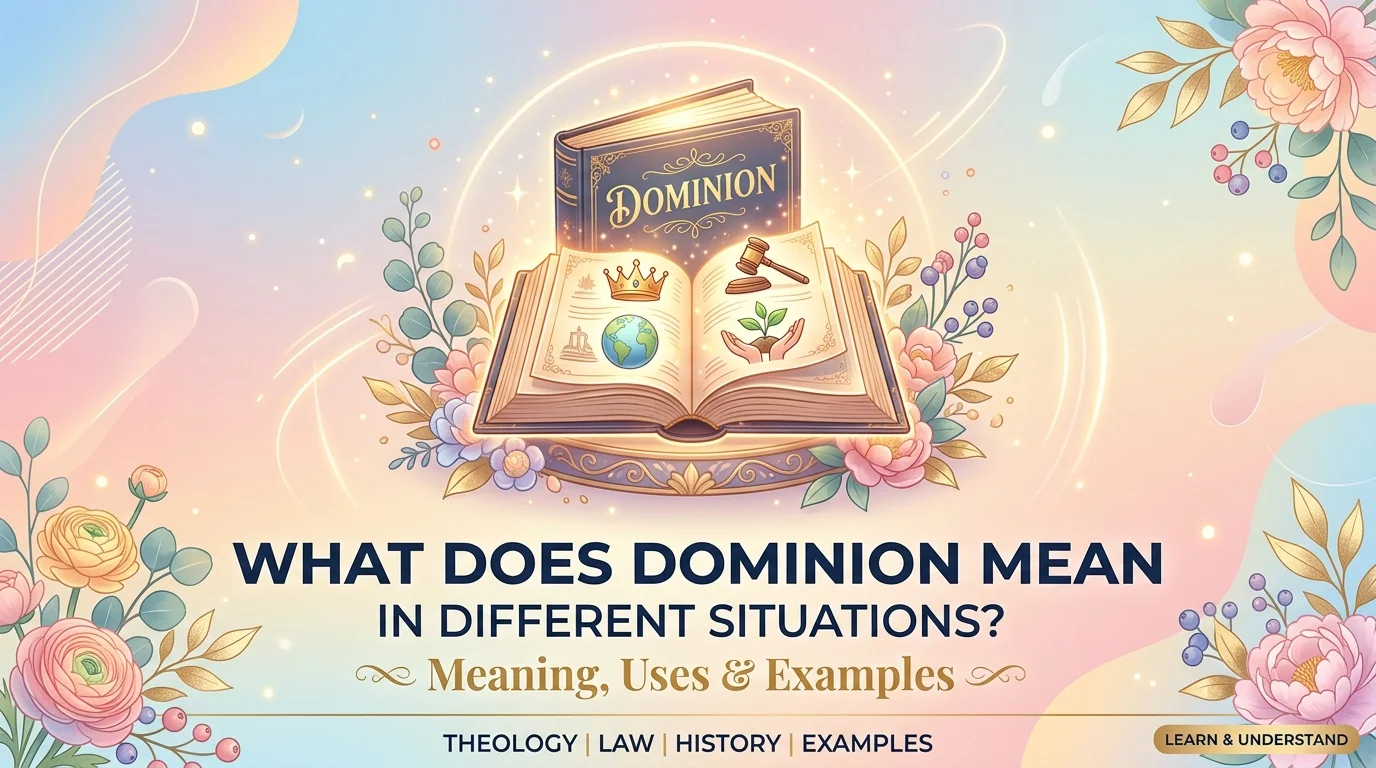
What Does Dominion Mean in Different Situations?
Dominion Meaning in History
In history, dominion often refers to control over lands, kingdoms, or territories.
Examples:
- Empires
- Monarchies
- Colonial rule
Example:
“The empire extended its dominion.”
Meaning:
The empire controlled more areas.
Dominion Meaning in Politics
In politics, dominion can mean authority or self-government.
Historically, some countries or territories were called dominions.
Example:
“The Dominion of Canada.”
Meaning:
A historical term for Canada’s status within the British Empire.
Dominion Meaning in Religion
In religious contexts, dominion often refers to authority or responsibility given over creation.
A common example comes from interpretations of the Bible, where humans are described as having dominion over animals and the Earth.
Meaning:
Humans have responsibility or authority.
Dominion Meaning in Law
In legal language, dominion can refer to control or ownership rights.
Example:
“He had dominion over the property.”
Meaning:
He had legal control or ownership.
Dominion Meaning in Everyday Conversations
People may use dominion when talking about:
- Personal control
- Influence
- Leadership
- Power
Example:
“Taking dominion over your future.”
Meaning:
Taking control of your decisions.
Origin and History of Dominion
The word dominion comes from Old French and Latin roots.
It developed from the Latin word dominus, meaning “lord” or “master.”
Over time, it became associated with:
- Ruling territories
- Having authority
- Possessing control
The word has been used for centuries in government, religion, and literature.
How People Actually Use Dominion
Most people encounter “dominion” in formal or serious contexts.
You’ll often see it in:
- History books
- Religious writing
- Political discussions
- Literature
- Legal language
When to Use It
Use dominion when discussing:
- Authority
- Control
- Leadership
- Rule
Examples:
“The leader had dominion over the region.”
“The athlete gained dominion over the competition.”
When Not to Use It
Avoid using dominion in casual situations where simpler words are clearer.
Instead of:
“I have dominion over my schedule.”
Say:
“I control my schedule.”
Real Examples of Dominion in Conversations
Example 1: Leadership
Person A:
“Who controls the kingdom?”
Person B:
“The ruler has dominion.”
Meaning:
The ruler has authority.
Example 2: Personal Growth
Person A:
“How did she change her life?”
Person B:
“She took dominion over her choices.”
Meaning:
She gained control.
Example 3: Business
Person A:
“Why does that company lead the industry?”
Person B:
“They have dominion in the market.”
Meaning:
They have strong influence.
Example 4: History
Person A:
“How did the empire grow?”
Person B:
“It expanded its dominion.”
Meaning:
It gained control of more territory.
Example 5: Nature
Person A:
“What does dominion over nature mean?”
Person B:
“It means authority or responsibility.”
Meaning:
Having influence over nature.
Example 6: Politics
Person A:
“What was a dominion?”
Person B:
“A self-governing territory under an empire.”
Meaning:
A historical political status.
Common Mistakes and Misunderstandings
Mistake 1: Thinking Dominion Only Means Ownership
Dominion can mean influence or authority, not only owning something.
Mistake 2: Assuming It Always Means Oppression
Dominion can describe responsibility or leadership, depending on context.
Mistake 3: Using It Too Casually
The word often sounds formal or powerful.
Similar Terms and Related Words
| Term | Meaning | Difference |
|---|---|---|
| Authority | Power to make decisions | More common word |
| Control | Ability to manage something | Everyday usage |
| Rule | Govern or command | Often political |
| Power | Ability to influence | Broader meaning |
| Sovereignty | Supreme authority | Usually for nations |
| Ownership | Legal possession | Focuses on property |
| Influence | Ability to affect others | Less direct control |
| Command | Order or leadership | More action-focused |
Is Dominion Positive, Negative, or Neutral?
Dominion is generally neutral.
Positive:
“She gained dominion over her fears.”
Meaning:
She gained control.
Negative:
“The empire forced its dominion on others.”
Meaning:
Control through force.
Neutral:
“The kingdom had dominion over the land.”
Meaning:
It ruled the land.
Should You Use Dominion?
Use It If:
- Writing formally
- Discussing history or religion
- Describing power or authority
Avoid It If:
- Simple language works better
- You are having a casual conversation
Related posts:
 Knesset Meaning Explained Powerful Guide to Its Definition, History, Role & Importance 2026
 Important PM2.5 Meaning Explained What Does PM2.5 Mean in Air Quality & Health? 2026
 Contempt of Court Meaning Shocking Legal Definition, Real Examples & Complete Guide 2026
 Harper Name Meaning Explained Beautiful Guide to Origin, History, Personality & Popularity 2026